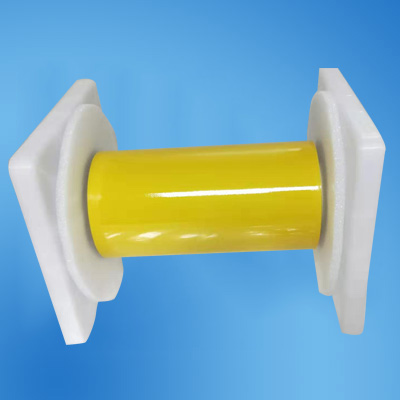
Halogen free yellow cover film (CVL) is the core protective material for flexible circuit boards (FPC). It is made of polyimide (PI) film as the substrate, coated with a halogen-free thermosetting epoxy resin adhesive layer, separated by release paper, and cured at high temperature. It has the advantages of halogen-free environmental protection, insulation and heat resistance, easy inspection, and bending resistance, and is widely used in the field of electronic manufacturing. It is a key material to ensure the stability and prolong the service life of FPC circuits.
1、 Product Overview
Halogen free yellow cover film is an insulating material used for surface protection of flexible printed circuit boards (FPC), consisting of three parts: polyimide (PI) film substrate, halogen-free flame retardant adhesive layer, and release protection layer. Its core features include: halogen content that meets international environmental standards (chlorine and bromine not exceeding 900ppm, total halogen not exceeding 1500ppm); The appearance is yellow, making it easy for automated optical detection equipment to identify and align; Has excellent heat resistance, insulation, and flexibility. This product is mainly used in electronic assembly scenarios that have strict environmental requirements and require high-precision visual recognition.
2、 Main application areas
1. Smartphones and consumer electronics products
The halogen-free yellow cover film is widely used in display module FPC, touch screen FPC, battery protection board FPC, antenna FPC and other components of smartphones. The yellow appearance facilitates visual alignment and pad recognition for SMT surface mount machines, especially in high-density interconnect boards, where light colored substrates help optical inspection systems accurately identify circuit defects. At the same time, the demand for environmental protection in the consumer electronics field is becoming increasingly strict, and halogen-free materials have become a basic entry requirement for mainstream brands.
2. In car electronic FPC
With the development of intelligent automobiles, a large number of in car camera modules, display screen connections, sensor FPCs, etc. are covered with yellow film. Automotive electronics require high reliability and weather resistance, and halogen-free yellow coating film needs to maintain stable insulation performance and adhesive strength in a temperature range of minus 40 ℃ to 125 ℃ or even wider. The yellow appearance facilitates visual inspection and automated optical testing on the production line, helping to improve the quality control level of the automotive electronics manufacturing process.
3. Industrial and medical equipment
In FPC applications such as industrial control equipment, medical imaging equipment, and precision instruments, halogen-free yellow coating film is used for areas that require high reliability insulation protection. Medical electronics have strict requirements for material biocompatibility and non-toxic environmental protection. Halogen free materials avoid toxic substances such as dioxins that may be generated by halogen combustion, which is more in line with the safety design concept of medical equipment.
4. New energy and battery management system
FPC is widely used for voltage and temperature sampling in the battery management system (BMS) of new energy electric vehicles, and halogen-free yellow cover film is used for surface insulation protection of these FPCs. The yellow appearance facilitates visual positioning and welding quality inspection of welding pads on automated production lines, while the halogen-free flame retardant system helps meet the increasingly stringent flame retardant and environmental regulations in the new energy industry.
3、 Quality Key Points and Control Methods
1. Halogen content control
The primary indicator of quality is to meet the halogen content standard. Require suppliers to provide third-party testing reports and use ion chromatography to test chlorine and bromine content according to IEC 62321 standard. During the production process, it is necessary to prevent cross contamination, including strict isolation from non halogenated product lines in areas such as raw material storage, gluing, coating, and cutting. Each batch of incoming materials is randomly inspected, and finished products are regularly sent for inspection to ensure compliance with halogen-free standards at all times.
2. Adhesive strength and peel strength
The adhesive strength between the cover film and the FPC substrate directly affects the reliability of the product. The standard requires a peel strength of not less than 0.8 kilonewtons per centimeter before and after thermal stress testing. Quality control includes: controlling the uniformity of adhesive layer thickness, with tolerances within plus or minus ten percent of the nominal value; Optimize the laminating process parameters, and match the curing curve of the adhesive with temperature, pressure, and time; Perform peel strength testing on each batch of products and compare them with standard samples.
3. Heat resistance and thermal stress testing
FPC needs to withstand high temperature reflow soldering at around 260 ℃ during SMT soldering, and the covering film must not have bubbles, delamination, discoloration, or embrittlement. The quality points include: using thermogravimetric analysis to detect the thermal decomposition temperature of the substrate and adhesive layer, which should not be lower than 300 ℃; Differential scanning calorimetry is used to test the glass transition temperature, which is usually required to be above 130 ℃; After conducting immersion welding test (288 ℃ for 10 seconds) and reflow soldering test (peak 260 ℃ three cycles), inspect the appearance and peel strength changes.
4. Dimensional stability
During the processing and lamination of the cover film, heating can cause expansion or contraction, which affects the alignment accuracy. The quality requirement is to control the dimensional change rate within plus or minus 0.15%. The control methods include: selecting PI substrates with low thermal shrinkage rate; Control the temperature uniformity of coating and drying processes; Measure the longitudinal and transverse thermal shrinkage rate of each batch; Ensure that the thermal expansion coefficient is similar to that of the FPC substrate. For high-density products with line width and spacing less than 0.1 millimeters, the requirements for dimensional stability are more stringent.
5. Insulation resistance and voltage resistance performance
As an insulating protective layer, the covering film must have excellent electrical insulation performance. Require insulation resistance to be no less than 1 × 10 ^ 12 ohms under normal conditions and no less than 1 × 10 ^ 10 ohms after wet heat treatment; The withstand voltage strength should be above 3 kV per millimeter. Quality inspection includes conducting dielectric strength testing in accordance with GB/T 1408 or IPC-TM-650 standards; Perform a damp heat aging test (such as 85 ℃ with 85% relative humidity for 168 hours) and retest the insulation resistance; Check whether there are defects such as bubbles and impurities inside the cover film that may reduce the pressure resistance.
6. Consistency in appearance and color
The appearance quality of yellow covering film directly affects the optical detection effect and product yield. The color should be uniform and consistent, and the color difference Δ E is usually required to be controlled within 1.5. The quality points include: no visible defects such as scratches, creases, bubbles, foreign objects, etc. on the surface; The release film peels off smoothly without any residual adhesive; Regularly detect color difference values using a spectrophotometer and compare them with a standard color palette; The color difference between the beginning and end of each roll of product must be within the allowable range. Excessive color deviation can lead to misjudgment or omission of automatic optical detection equipment.
7. Chemical resistance and resistance to moisture and heat aging
FPC may come into contact with cleaning agents, solder residue, sweat, salt spray, and other substances in the usage environment. The covering film needs to have good chemical corrosion resistance, which is verified through immersion testing. After passing the Double 85 Test (85 ℃, 85% relative humidity for 500 or 1000 hours), the resistance to moisture and heat aging should be checked for blistering and delamination, and the decrease in peel strength should not exceed 30%. For in car and outdoor applications, salt spray testing and temperature cycling testing need to be added.
8. Processing adaptability
The covering film should be easy for FPC manufacturers to perform post-processing such as drilling, punching, alignment, and lamination. Require neat cutting edges without burrs or delamination; The drilling position is not offset, and there is no adhesive overflow on the hole wall; The release force of the release film is moderate, and there is no residue or tearing of the adhesive layer during manual or automatic peeling. Quality control includes: providing suggestions on processing parameters; Cooperate with customers to verify the yield of small batch processing; Provide corresponding processing guidance for cover films of different thicknesses.
4、 Common Quality Issues and Countermeasures
The common reason for blistering of the cover film is that the laminating temperature is too high or the pressure is insufficient. The corresponding measures are to optimize the laminating parameters and conduct temperature pressure matrix tests. Low peel strength is usually due to insufficient curing or poor surface cleanliness of the substrate. The curing time should be extended and the plasma cleaning effect should be checked. Alignment deviation is often caused by the mismatch between the thermal shrinkage rate of the cover film and the substrate, and a matching cover film model needs to be selected and preheated. The adhesive problem on the solder pad is caused by insufficient accuracy of the opening size of the cover film or punching offset. It is necessary to improve the accuracy of the punching mold and control the temperature and humidity of the punching environment. The large color batch difference is caused by fluctuations in the adhesive formula or coating process, and it is necessary to strengthen color difference control between batches and lock the process window. Automatic optical detection misjudgment is caused by excessively dark colors or high glossiness. Color difference and surface glossiness should be controlled to adapt to the detection equipment.
5、 Selection and acceptance suggestions
When purchasing halogen-free yellow cover film, it is recommended to focus on the following issues:
Clarify the environmental protection level requirements, whether they comply with IEC 61249 or stricter customer standards. Confirm the heat resistance level. For ordinary SMT soldering, the standard heat resistance type is sufficient. For lead-free reflow soldering, it is recommended to choose the high heat resistance type. Matching substrate types, PI substrates and copper foil types from different manufacturers have different compatibility with the cover film. Please provide validation data for the same material combination from the supplier. Request a complete quality report, including key indicators such as halogen testing, peel strength, insulation resistance, heat resistance, and dimensional stability. Conduct small-scale trial production verification to test the processing yield and reliability under actual production conditions, especially for high-density and fine pitch products, which cannot be skipped.
Conclusion
As an environmentally friendly FPC insulation and protection material, halogen-free yellow covering film plays an important role in the fields of consumer electronics, automotive electronics, medical equipment, and new energy. Its quality control covers multiple dimensions such as halogen content, adhesive strength, heat resistance, dimensional stability, insulation performance, and appearance consistency. Any defect in any link may lead to the failure of FPC in subsequent assembly or use. Choosing the right materials, managing the process well, and conducting strict inspections are the key to ensuring that the halogen-free yellow coating film performs as expected. With the development of electronic products towards miniaturization, higher density, and environmental friendliness, the quality requirements for halogen-free yellow coating films will continue to increase. Material suppliers and FPC manufacturers need to continuously optimize their processes and improve their testing methods to meet the market's demand for high-quality and high reliability FPCs.




